



Rural Roads, Real Wisdom: What Farmers, Ranchers and Rural Drivers Know About Staying Safe
A History Written on Dirt Roads
Long before Polk County’s roads carried commuters and freight trucks, they carried horses, wagons and farm equipment. A team hitched to a sickle bar mower or hay rake moved slowly along narrow dirt paths, every curve a blind spot and every soft shoulder a potential collapse. Families who lived and worked in rural areas learned early that country roads require caution and that a simple mistake can have serious consequences. Vision Zero embraces that same understanding. Rural roads may feel familiar, but they come with risks that people who live in the area understand better than anyone.
The Reality of Rural Road Risk
Rural roads are more dangerous than most people realize. According to the Federal Highway Administration (FHWA) , more than 83,000 people in the U.S. died on rural roads from 2017 to 2021. That is 43% of all roadway deaths, even though only about 20% of Americans live in rural areas. In Polk County, rural roads include portions of State Road 60 to the east, State Road 37 to the south, and State Road 33 to the north.
Many rural roads have:
- Hilly or steep grades that hide slow‑moving vehicles or wildlife.
- Sharp curves in roads, designed decades before modern traffic speeds or even cars.
- Gravel or dirt surfaces that reduce traction and increase stopping distance.
- Narrow lanes and shoulders that leave little room for error.
- Limited lighting and signage compared to more urban networks.
- Livestock and wildlife that can appear suddenly.
- Slow‑moving farm equipment that may travel at 15–20 mph.
Roadway departure crashes account for roughly one third of all traffic deaths nationwide. The FHWA defines a roadway departure crash as one in which a vehicle crosses an edge line, center line or leaves the traveled way.
How do Farmers and Ranchers Move Equipment Safely?
Farmers and ranchers move large, heavy and slow equipment on roads. Their safety habits come from generations of experience:
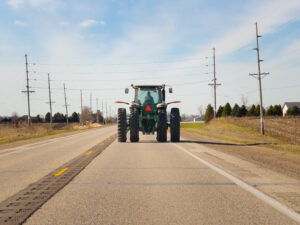
- Clean SMV emblems. Slow Moving Vehicle (SMV) triangles must stay clean and bright. Dust, mud and sun fading make them harder for drivers to see, so experienced operators clean or replace them when needed.
- Safe pull‑over practices. Equipment only pulls over when it is truly safe, not on soft shoulders, blind hills or tight curves where stopping could cause a crash.
- Avoiding nighttime moves. Most farmers avoid moving equipment after dark because low visibility makes it harder for drivers to spot them.
- Proper lighting and markings. Flashers, headlights, reflective tape and escort vehicles help other drivers see equipment from farther away.
- Hitching to the drawbar. Farm hands hitch only to the tractor drawbar to prevent rear overturns, which are among the deadliest tractor incidents.
- Keeping speeds below 20 mph. Self‑propelled equipment and tractors pulling trailers stay under 20 mph because most machinery is not designed for higher speeds.
- Safe towing ratios. Loads should not weigh more than four times the tractor’s weight to maintain control and stability.
- Using roll bars. If a tractor has no cab, installing roll bars is one of the most effective ways to prevent fatal injuries.
What Rural Drivers Know About Their Roads
People who drive rural roads every day learn to see them differently. A hill is not just scenery. It is a place where you cannot see what is coming. A curve is not a shortcut. It is a spot where a driver can drift into the wrong lane. A gravel road is not a casual detour. It is a surface that can shift under your tires.
Drivers who live in rural areas understand these risks because they see them every day. They know that a slow moving tractor might be just over the next hill, that livestock or wildlife can appear suddenly and that narrow shoulders leave little room to recover if a mistake happens.
Rural drivers also know that many crashes stem from speed, distraction and overconfidence, behaviors that become more dangerous on roads with narrow lanes, limited lighting and high-speed travel. Research by the National Center for Rural Road Safety shows that rural drivers historically have lower seat belt use and higher rates of child-restraint misuse than urban drivers. Vision Zero addresses these risks through education, engineering and community partnerships.
How Vision Zero Supports Rural Communities

Vision Zero recognizes that rural areas need different safety solutions because the roads themselves are different. The Safe System approach focuses on safer roads, safer speeds, safer vehicles, safer road users and post-crash care.
The Federal Highway Administration lists Proven Safety Countermeasures (PSC) that reduce serious crashes, including rumble strips, wider shoulders, clearer pavement markings and curve improvements.
These tools help reduce the types of crashes that happen most often on rural roads, especially roadway departures and high-speed collisions. Vision Zero treats these crashes as preventable. It focuses on designing roads that forgive mistakes and improving visibility so drivers have more time to react.
Vision Zero also emphasizes community knowledge. People who live and work in rural areas understand their roads better than anyone. Their experience helps identify problem spots, risky curves, common wildlife heavy areas and places where additional lighting or signage could make a difference. When local knowledge and proven safety strategies work together, rural roads become safer for everyone.
A Shared Road, A Shared Responsibility
Farmers, ranchers and rural drivers bring generations of experience to the road. Vision Zero provides a framework that turns that experience into action by engineering safer roads, supporting safer behaviors and working toward a future where no one is killed or seriously injured on Polk County’s rural road system.
The Southwest Center for Agricultural Health, Injury Prevention and Education offers clear guidance for drivers who share the road with farm equipment:
- Know the size of farm equipment. A typical rural road is 18 to 20 feet wide. Many pieces of farm equipment are about 13 feet wide, leaving very little room for passing. Most cars are only about 6 feet wide.
- Reduce speed as soon as you spot farm equipment ahead.
- Watch for hand signals for equipment operators.
- Look for the Slow-Moving Vehicle emblem.
- Watch for flashing amber lights.
- Never speed past farm equipment.
- Do not pull out in front of slow equipment.
- Do not expect equipment to stay on the shoulder.
Rural roads connect us to work, to home and to each other. Keeping them safe is a shared responsibility. Vision Zero helps ensure that lessons learned over generations continue to guide the safety of the future.