


How Vision Zero supports safer school travel in Polk County
For thousands of Polk County families, the school bus is part of the daily routine. The trip includes the walk to the stop, a place to wait and the ride to school. Each part offers opportunities to support safer, more comfortable travel.
Polk County Public Schools transports around 50,000 students daily through a network of 5,900 bus stops.
Through Vision Zero Polk, the Polk Transportation Planning Organization (TPO) works toward eliminating traffic deaths and serious injuries. For students who ride the bus, that includes considering the roads they cross and the places they wait.
Looking at the whole trip
Bus stops serve neighborhoods with different road conditions. Some areas have connected sidewalks and marked crossings. Others may have gaps in the walking route, no sideways, limited lighting or less space to wait away from traffic.
The TPO’s school sidewalk assessment identified gaps along major roads within one mile of public schools. That information can help guide planning for walking routes near campuses.
Local pedestrian projects offer examples of improvements that have been made. At Havendale Boulevard and U.S. Highway 17, a Florida Department of Transportation project completed in February 2025 added high-visibility crosswalks and realigned sidewalks to connect with them. A separate FDOT project completed in 2024 improved crosswalk markings, pedestrian countdown signals and lighting near Cypress Gardens Boulevard and U.S. Highway 17.
The Polk TPO also looked at Kathleen Road in Lakeland in a March 2026 safety workshop series, inviting residents to discuss their experiences and potential solutions.
When drivers must stop for a school bus
Florida law requires drivers to stop while a stopped school bus displays its stop signal and wait until that signal is withdrawn. Drivers traveling in the same direction as the bus must stop.
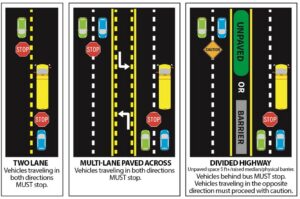
Source: Polk County Public Schools
An exception applies to traffic approaching from the opposite direction when a highway is divided by a raised median, a physical barrier or an unpaved space at least 5 feet wide. A paved center turn lane does not qualify.
Polk County Public Schools and the Polk County Sheriff’s Office partner on the Safe Stop program, which involves stop‑arm cameras on over 500 buses. Cameras record evidence of illegal passing, and law enforcement reviews that evidence before a violation is issued.
Drivers can support safer trips by following posted speed limits, putting phones away and watching for children near bus stops. Families can help children become familiar with their route and review the bus driver’s instructions for boarding, leaving and crossing near the bus.
Vision Zero supports safer routes to school
Everyday habits work alongside improvements to roads, crossings and bus stops. Vision Zero brings these efforts together through road design, speed management and education.
Depending on the location, safer street improvements include:
- Street and sidewalk design: Adding sidewalks, crosswalks, lighting and appropriate traffic calming near bus stops.
- Speed management: Slower speeds to reduce crashes and severe injuries.
- Bus stop placement: Reviewing locations to improve visibility, waiting space and crossings.
- Targeted enforcement: Focusing law enforcement patrols where illegal passing happens most.
- Community education: Sharing school bus stopping rules and guidance for walking to bus stops.
The Federal Highway Administration identifies walkways, lighting and crossing improvements among its proven safety measures. Each location requires review to determine which changes fit its conditions.
Connecting local knowledge with planning
The Polk TPO helps identify transportation needs and guide planning priorities with local partners. Polk County Public Schools manages bus routes and stops. Street and crossing improvements involve the county, cities or FDOT, depending on who manages the road.
Families’ observations can help identify places that may benefit from a closer look, such as a sidewalk that ends before a bus stop or a view blocked by vegetation.
Questions about bus routes and stops can be directed to the school district’s transportation office. Concerns about walking connections or road safety can be shared with the Polk TPO. Details such as the location, time of day and specific concern can help agencies better understand the conditions.
The Vision Zero Promise
Vision Zero is not a slogan. It is a commitment to designing a transportation system where no one killed or seriously injured on the way to school. Polk County’s roads can be safer, calmer and more predictable. Every improvement, new sidewalk, raised crosswalk or redesigned bus stop, moves us closer to a future where families do not have to fear their child’s morning commute.